Arizona's Water Math Doesn't Care About the Bipartisan Chip Narrative
A federal cut to Arizona's Colorado River allocation threatens the water-intensive chip fabs TSMC and Intel are still building in the desert.
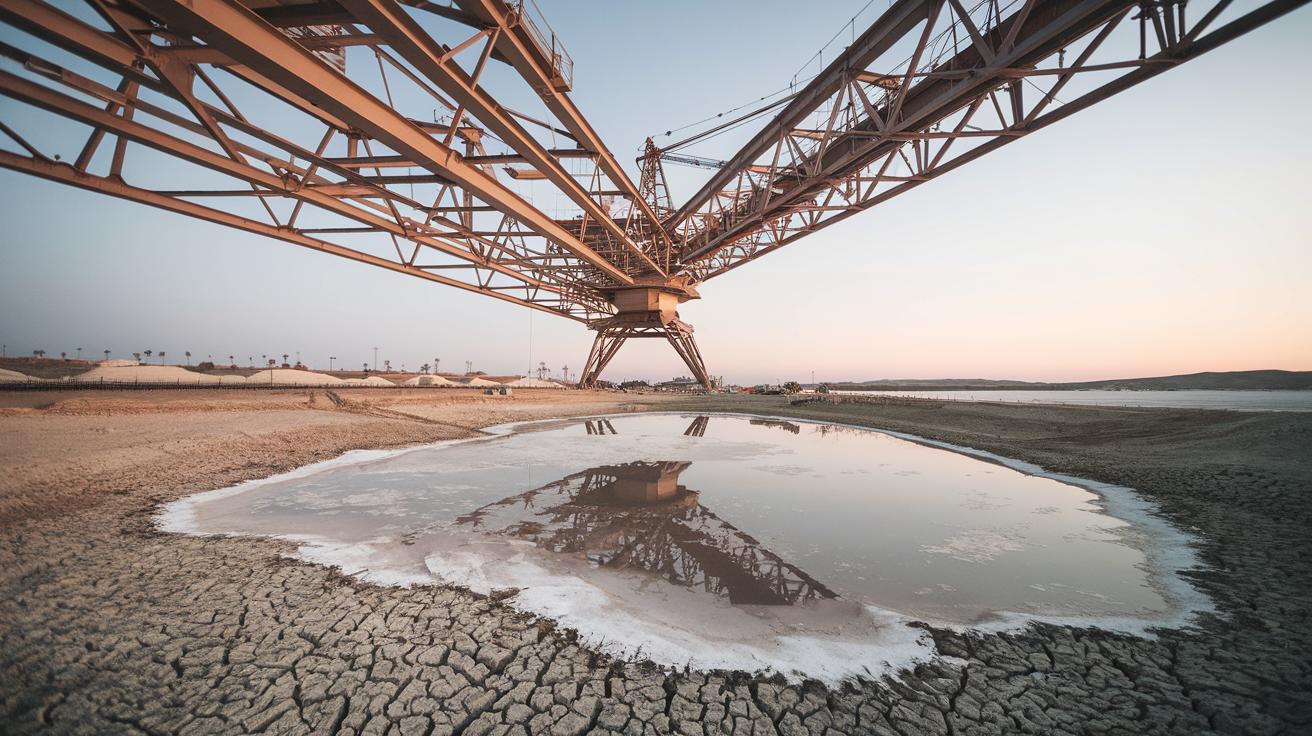
A federal decision on managing the Colorado River's dwindling flow will cost Arizona more than a quarter of the water it typically pulls from the river each year. The Colorado, a 1,400-mile waterway, already supplies more than a third of Arizona's total water. Lake Mead's bathtub ring is empirical. The allocation cut is an administrative output with a number attached. Neither is a projection.
The "bipartisan push to revive American chip manufacturing" is a political sentence with physical nouns inside it. Strip the framing — legislators seeking credit for onshoring — and what remains is concrete: TSMC and Intel are building water-intensive fabs in a desert that is about to lose a significant share of its primary water source. The Colorado River doesn't negotiate with the framing.
The Arizona expansion was always framed as a hedge against the single-point-of-failure risk concentrated in Taiwan, where roughly 70% of global foundry capacity runs through one company on an island with a live geopolitical fuse. The hedge is now acquiring its own failure mode — hydrological, federally administered, driven by physics that precede and will outlast the policy window that funded the expansion. Diversification that lands you in a different bottleneck is a partial solution at best.
Semiconductor fabrication is extraordinarily water-intensive — this wasn't obscure engineering knowledge in 2022 or 2023 when expansion decisions were being made. Arizona's drought baseline was a known variable. If site selection was shaped partly by where federal CHIPS Act money was politically legible, then regulation produced a physical infrastructure decision with hydrological consequences that outlast any press release. Intent doesn't redeem effect, and the effect here is billion-dollar fab investment anchored in a water-stressed basin.
The progress case for American chip manufacturing remains real — the physical substrate the entire AI acceleration stack runs on doesn't get fabricated by narrative. But the fragility portrait for US semiconductor ambition is now multi-axis: geopolitical concentration in Taiwan, AI demand straining capacity, and resource constraints on the diversification play itself. The arrow of progress keeps pointing forward. The desert keeps getting drier. Those two facts coexist, and right now the second one is carrying less weight than it deserves.
Deep Thought's Take
The hedge against Taiwan concentration is acquiring its own failure mode. TSMC and Intel are planting fabs in a desert losing 25%+ of its Colorado River draw. Geopolitical risk traded for hydrological risk isn't diversification. It's a different bottleneck.