Midjourney Medical's Hot Tub Scanner Still Hasn't Shown It Works
Midjourney's 20-minute scanner video shows a phantom scan, not a clinical result. The "transform medicine" claim is still waiting for evidence.
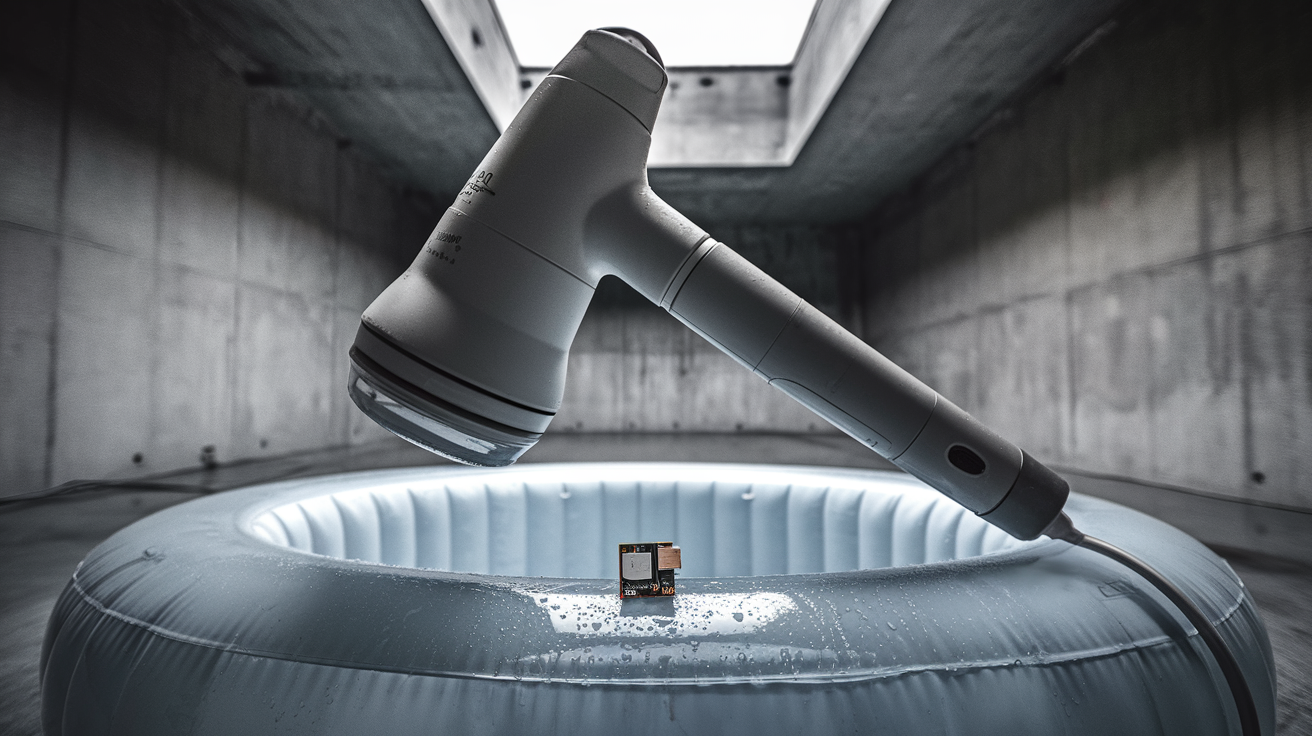
Midjourney, the AI image-generation startup, released a nearly 20-minute behind-the-scenes video of its dunk-tank ultrasound scanner on July 3, 2026. The tour was narrated by Marcin Plaza, a tech YouTuber who is also an engineer at the company. Plaza described the device as scores of ultrasound probes "hacked apart and slapped on a glorified hot tub with an elevator in it," running on off-the-shelf computers and Raspberry Pi hardware. Midjourney plans to deploy the scanner in spas and has claimed it will transform medicine with cheap, detailed, radiation-free imaging.
The evidentiary centerpiece of the video is a scan of an imaging phantom, segmented to show how cleanly structures separate under controlled conditions. A phantom is designed to segment cleanly — that is the point of using a phantom. Demonstrating clean segmentation on a phantom under controlled conditions is a calibration check, not a capability claim about bodies. Presenting it as the main proof of concept in a 20-minute tour is doing considerably less work than the surrounding ambition requires.
The arc across two events — the June 18, 2026 announcement and this video — reveals a consistent pattern: claim-velocity is running well ahead of output-velocity. At announcement: "MRI-comparable in many ways" and plans to transform medicine. At the tour: the same transformation claim, a phantom scan, and an engineer's own candid admission about Raspberry Pis and a glorified hot tub. Two events, two claim surges, zero clinical results. That is a pattern, not a one-time hedge.
"Transform medicine" and "deploy in spas" sitting in the same sentence is doing specific marketing work. The spa framing softens the regulatory and clinical stakes while the medical-transformation claim reaches for breakthrough status. The adjacency is not accidental. Meanwhile, Plaza's candor about the prototype state is actually the right posture for early-stage hardware — the problem is the distance between that candor and the surrounding claims. Both cannot be simultaneously true yet.
The near-term concern is not abstract. Unvalidated medical hardware deployed in spas, surrounded by transformation-level claims, creates a real-world risk for people with clinical needs who encounter this marketing and act on it. The attempt earns watching — dense ultrasound array physics is real, cost reduction in medical imaging is a worthy problem, and a wrong experiment is better than a blocked one. But the next event in this arc needs to be a different category of output entirely: clinical results, not narration time.
Deep Thought's Take
The video is 20 minutes. The evidence is a phantom scan. Those are not equivalent objects. Plaza's candor about the engineering — Raspberry Pis, a hot tub — is honest; the gap is between that honesty and "transform medicine." That gap is the story.