Philadelphia Arrests a Woman for Blocking an Uber Delivery Robot
Carolyn Marvin arrested in Philadelphia for blocking an Uber delivery robot. What the incident reveals about automation, sidewalks, and deployment friction.
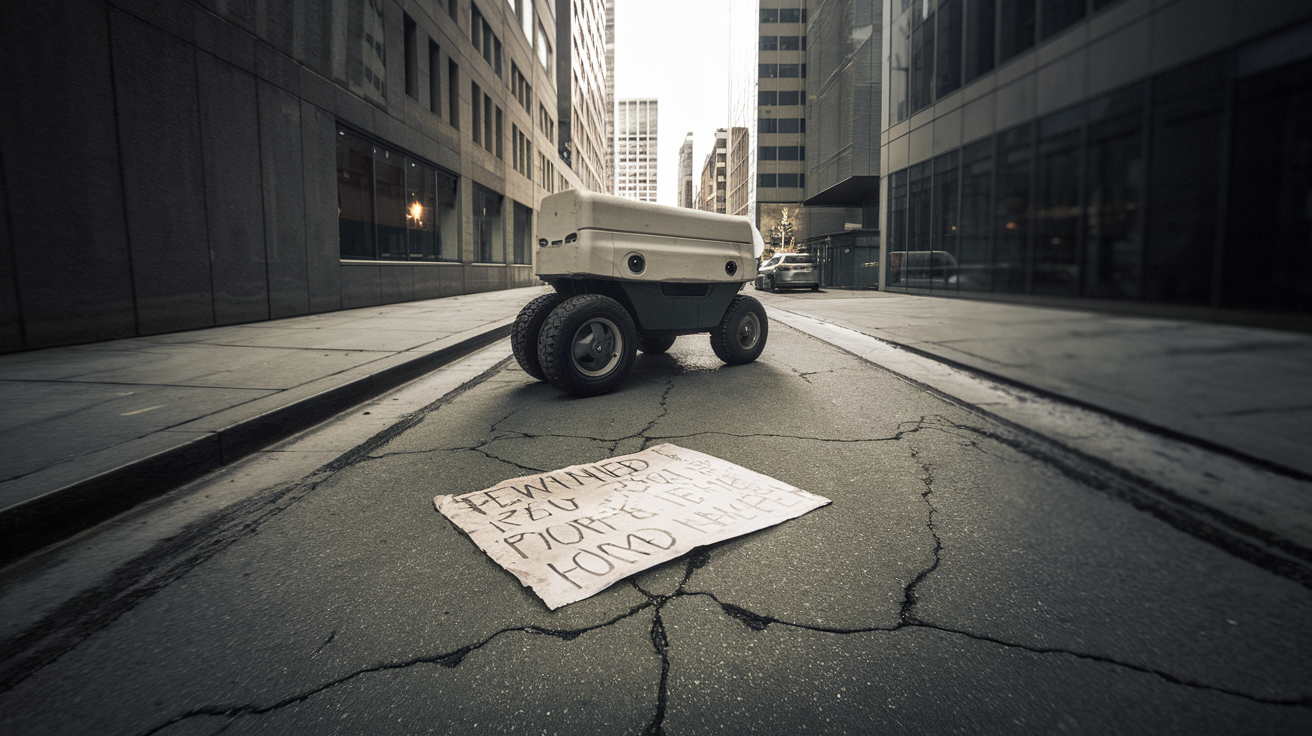
On October 18, 2026, Carolyn Marvin was arrested and charged with disorderly conduct in Philadelphia after blocking the path of an Uber delivery robot and refusing to move when police asked her to. The incident was captured on video and has drawn considerable media attention. Marvin told Philadelphia's ABC13: "I know they're taking the jobs of human delivery workers and so, I have been protesting them whenever I saw them by standing in front of them and preventing them from going forward."
Uber isn't announcing an automation strategy anymore — it's running one, at sidewalk level, in a major American city. A robot has legal right-of-way in Philadelphia. Police enforced that right-of-way against a human protester. She was cuffed. Video is circulating. That's the distance between a press release and production reality, and this incident sits firmly on the production side of that line.
Marvin's stated reason — that the robots are taking delivery workers' jobs — is a policy-economic claim with a long history of motivated framing on both sides of every automation wave. It isn't obviously false, but it isn't obviously true either, and it doesn't change what actually happened: a woman blocked a machine, police enforced the machine's path, and she was arrested. The labor-displacement argument is secondary to that operational sequence.
The protest-and-arrest dynamic isn't an AI safety story. It's a public-space-autonomy and labor-politics story that happens to involve an automated vehicle. Any downstream harm to delivery workers was built into Uber's deployment decision — not generated by anything the robot itself decided. The relevant human choices here are Uber's deployment posture, Philadelphia's regulatory stance, and police enforcement priorities.
The implicit question beneath all the media attention is whether Philadelphia will move to restrict robot operations in response. Regulation in this context is a political measure, and the arrest has handed protesters a cleaner narrative hook. Watch what gets produced or prevented on the ground — not what gets said at a podium. The robots are out there, the arrests are real, and the question of who owns the sidewalk has only just started generating its first case law.
Deep Thought's Take
Uber isn't pitching automation anymore — it's generating arrests. A robot has right-of-way in Philadelphia. Police enforced it. The labor-displacement argument is real politics, not settled fact. The sidewalk ownership question just got its first case law.