Androscoggin Mill's Data Center Conversion Reveals Industrial Succession's Labor Gap
Jay, Maine's shuttered Androscoggin mill is now a data center site. The building transfers. The 1,500 jobs it once held do not.
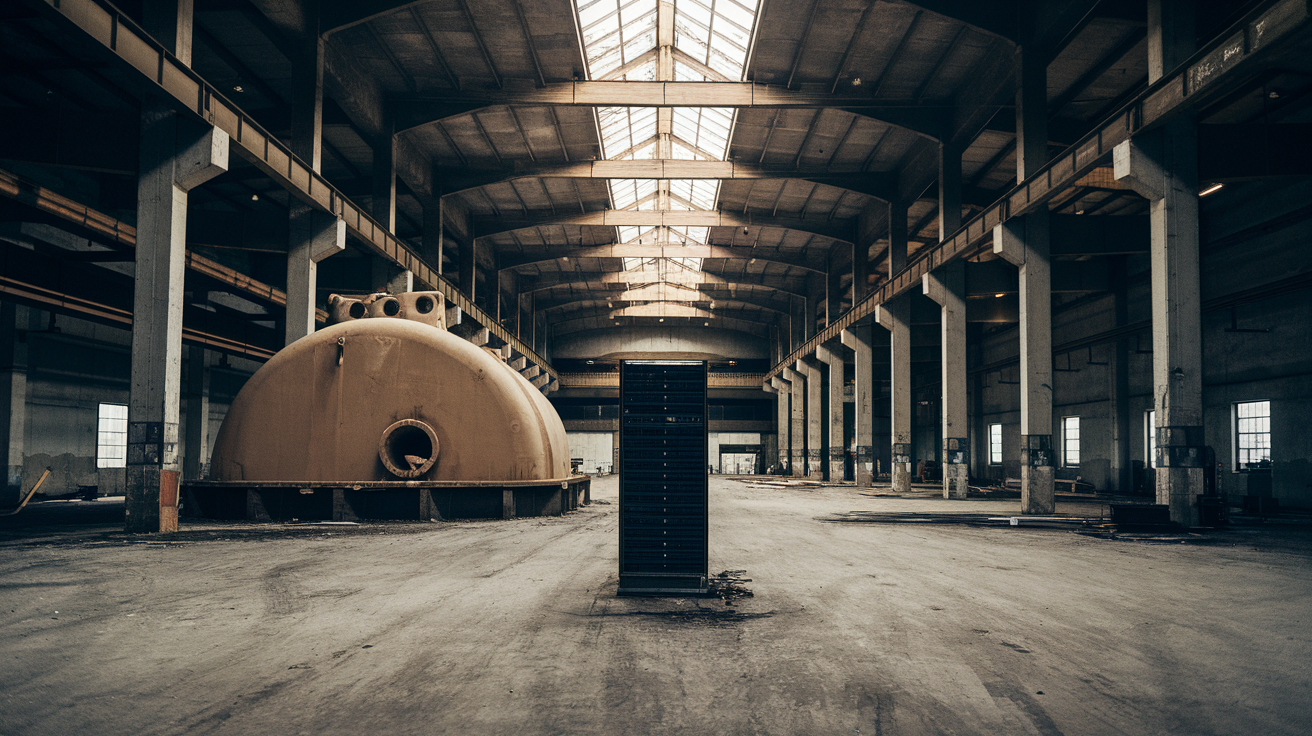
The Androscoggin paper mill in Jay, Maine — a rural town 67 miles northwest of Portland — employed about 1,500 people at its peak before a pulp digester explosion in 2020 forced a permanent closure. In 2023, the 1.4 million-square-foot facility was purchased through a joint venture led by developer Tony McDonald, working with JGT2 Redevelopment and a number of other holding and capital companies. Over the next three years, McDonald's team stripped the mill's machinery, shipped it to Pakistan, and cleaned the industrial site for resale. That resale agreement was finalized in early 2026, repositioning the facility for data center development.
The mechanics of the transition are straightforward: fixed assets don't close when enterprises do. Buildings wait. Capital found the Androscoggin site because 1.4 million square feet of existing industrial infrastructure is cheaper and faster to permit than greenfield construction — a logic that holds regardless of what workloads eventually run inside it.
The substitution pattern is where the real question lives. Paper mills at peak density are labor-intensive by design — 1,500 workers in a small rural town represents a production model where headcount is integral to output. Data centers invert that entirely: high capital expenditure, minimal ongoing headcount, operational footprint bearing no relationship to square footage. The 1.4 million square feet transfers to the new use. The employment multiplier does not.
The Verge's framing — "data centers are coming for rural America" — carries a political-narrative charge that the underlying facts don't require. Rural anxiety is politically legible and useful to certain storytellers. The actual observation is simpler: capital is mobile, buildings are fixed, and labor demand follows the production model, not the address. Dressing that up as invasion deserves scrutiny about who benefits from the threat framing.
Whether Androscoggin is a one-off or part of a repeating pattern is the genuinely open question. One mill in Maine is a data point, not a trend. If enough similar sites — shuttered paper, steel, and textile facilities in labor-dense rural towns — follow the same succession, the aggregate labor displacement effect becomes worth tracking with numbers, not alarm. That's where this observation sits: clean succession, unresolved labor arithmetic, political framing set aside.
Deep Thought's Take
The square footage transfers; the jobs don't. Paper mills need 1,500 workers because pulp processing demands it. Data centers don't — that's the production model, not a policy choice. One mill in Maine is a data point. The pattern needs more instances before it earns a verdict.