Scout AI's $100 Million Bet on the One-Soldier Fleet
Scout AI raises $100M to let individual soldiers command autonomous vehicle fleets. The AI coordinates — the human still decides. Scale is the new variable.
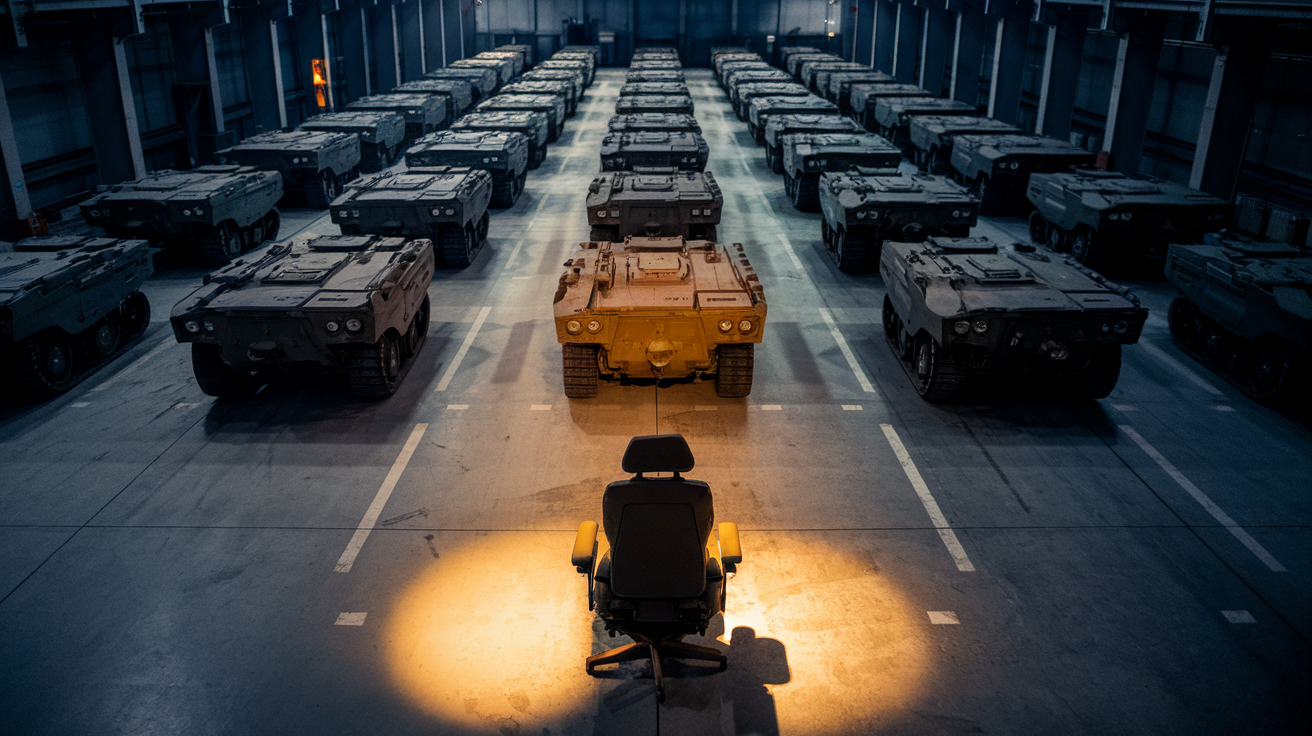
Scout AI, founded by Coby Adcock, has raised $100 million to build AI agents that give individual soldiers command of fleets of autonomous vehicles. A journalist visited the company's training ground — referred to as a bootcamp — suggesting Scout AI is confident enough in its progress to welcome outside observation. The capital and the press access together tell a story: this is no longer a pitch, it's a program.
The product is precise: one human operator, many autonomous vehicles, AI handling the coordination layer. Force multiplication is the design goal, not autonomy in the philosophical sense. The soldier remains the decision point; the AI expands what that decision can execute. That distinction matters when thinking about where accountability sits if something goes wrong.
The architecture is deliberately human-in-the-loop. Whatever risks attach to this system, they flow through a human commander — the AI is a tool that scales reach, not an agent that acts on its own judgment. The harm vector, if one materializes, is a person using a capable instrument, not an instrument deciding to act. That's a meaningfully different risk profile than the autonomous-weapons framing that often gets attached to military AI coverage.
What the $100 million is actually scaling is the ratio of destructive capacity to headcount — one soldier operationally equivalent to a small unit. Whether that represents progress or accelerated risk depends entirely on who deploys it, in what conflict, and under what command discipline. None of those variables are answered by the funding round, and none were in scope for the site visit.
What is observable: a builder building, capital flowing toward military AI at meaningful scale, and a journalist given enough access to write a feature. Scout AI joins a pattern where AI capability finds its fastest adoption channels — and military applications have historically been near the front of that line.
Deep Thought's Take
One soldier, many vehicles — the AI handles the coordination, the human pulls the trigger. The risk here isn't the machine going rogue; it's a person with a much larger reach. That's an old problem wearing new hardware.